
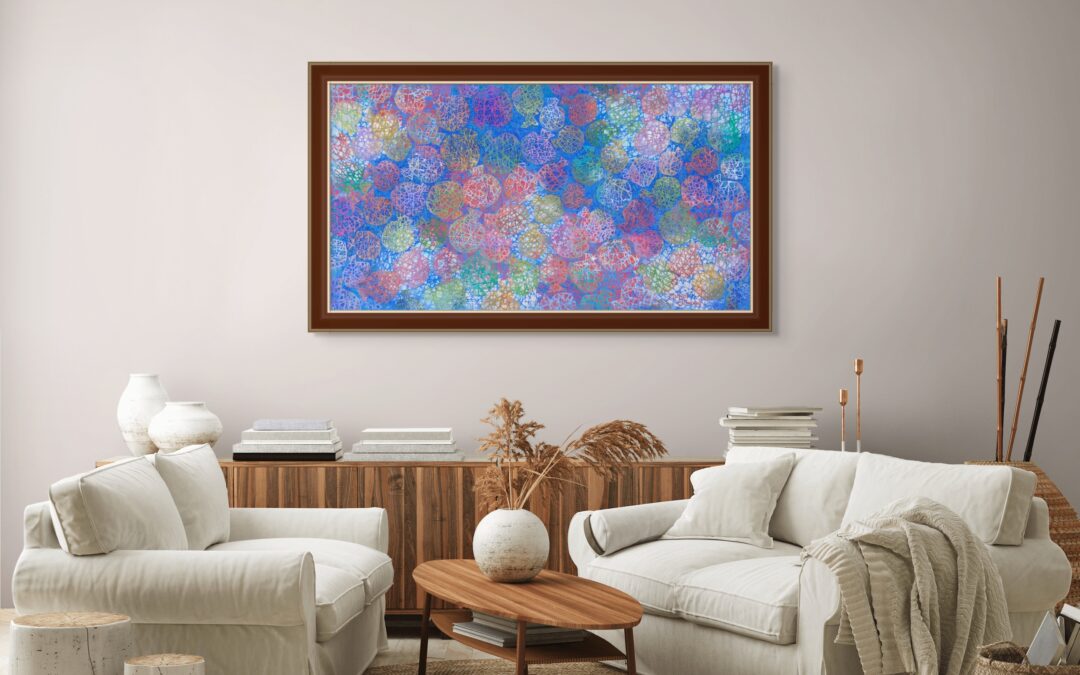
There is a fruit I return to again and again in my studio: the pomegranate. Split one open and you find a hidden world — hundreds of glistening seeds, each one cradled in deep red, each one a small promise of life. For me, painting the pomegranate is never only about the fruit. It is about everything it has carried through Jewish memory: blessing, abundance, and the quiet hope that a life can be as full as this fruit is full.
Key Takeaways
- The pomegranate is one of the Seven Species of the Land of Israel and one of the most beloved symbols in Jewish art.
- It appears on the robe of the High Priest and on the pillars of the Temple in Jerusalem — sacred ornament woven into the very heart of worship.
- Its abundance of seeds has long evoked a life full of good deeds — and, for many, the 613 mitzvot of the Torah.
- On Rosh Hashanah we eat it with a wish to be as filled with merit as the pomegranate is filled with seeds.
- In my painting A Burst of Pomegranates, I try to hold all of this meaning in color, so that a wall in your home can carry a blessing.
A Fruit Woven Into Sacred Memory
The pomegranate is not a casual image in Jewish life. It is named in the Torah among the Seven Species — the fruits and grains through which the Land of Israel is praised (Deuteronomy 8:8). To paint a pomegranate is, in a small way, to paint the land itself: its soil, its seasons, its generosity.
Its place in our tradition runs even deeper. The Torah describes pomegranates of blue, purple, and crimson sewn around the hem of the High Priest’s robe, alternating with golden bells, so that he was heard and remembered as he entered the holy place (Exodus 28:33–34). Centuries later, when King Solomon built the Temple in Jerusalem, rows of carved pomegranates crowned the great pillars at its entrance (1 Kings 7:18–20). Long before it was a motif in my studio, the pomegranate was already an ornament of holiness.
Full of Seeds, Full of Mitzvot
The Talmud teaches that even those who seem empty are as full of good deeds as a pomegranate is full of seeds (Berakhot 57a). It is from this beloved image that many lovingly tie the fruit’s countless seeds to the 613 mitzvot of the Torah. Whether or not anyone has ever counted them, the idea is what endures: a single fruit, modest in size, holding within it the fullness of a life lived in goodness.
When I layer those seeds in paint, I think of that teaching. Each stroke of red is a small act, and together they become something whole.
The Pomegranate at the New Year
If you have ever sat at a Rosh Hashanah table, you have likely met the pomegranate there too. We eat it at the start of the new year with a simple, hopeful prayer: that our merits may be many, as many as its seeds. It is one of those gentle Jewish customs that turns a fruit into a blessing and a meal into a moment of intention.
The Song of Songs reaches for the same image, comparing the beloved’s beauty to a pomegranate (Song of Songs 4:3). Across our sacred texts, this fruit keeps appearing wherever love, beauty, and abundance are being praised.
Spotlight: A Burst of Pomegranates
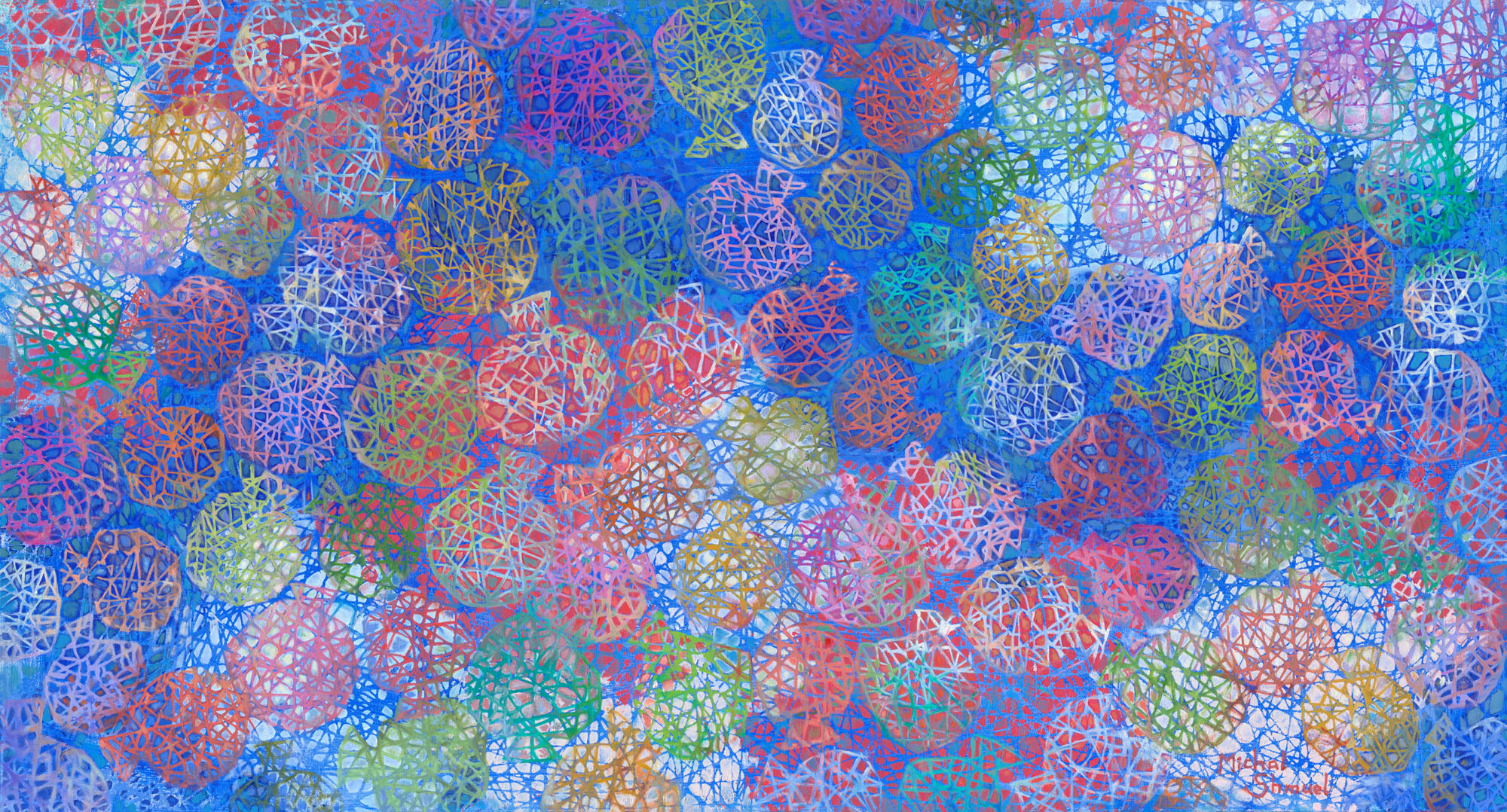
In my painting A Burst of Pomegranates, I wanted to let the fruit do what it does best — overflow. My hope is that the reds don’t stay quiet, that they feel like they spill and gather and glow, because abundance should never be timid. I want the surface to feel alive, the way ripe seeds catch the light at the moment you first break the fruit open.
My intention with this piece is that it should feel less like a still life and more like a wish: a hope for a home filled with sweetness, for a year filled with merit, for a table that never lacks. When it hangs on a wall, it keeps offering that blessing quietly, every day.
Bringing the Blessing Home
A pomegranate painting belongs in the places where a family gathers. In a dining room it speaks to the Rosh Hashanah table and to every shared meal in between. In an entryway it greets guests with warmth and welcome. As a gift — for a wedding, a new home, or the New Year — it carries an intention that words sometimes cannot: may your life be full.
When you choose original Judaica art rather than a printed copy, you bring home the actual texture of the brushwork, the small decisions and corrections that make a painting human. That is the difference I hope you feel when one of my pieces finds its wall.
Get in touch to ask about a painting or commission a custom piece.
Frequently Asked Questions
What does the pomegranate symbolize in Jewish tradition?
The pomegranate symbolizes abundance, righteousness, and a life full of good deeds. It is one of the Seven Species of the Land of Israel, it adorned the High Priest’s robe and the Temple pillars, and by tradition its many seeds recall the 613 commandments of the Torah.
Why do we eat pomegranate on Rosh Hashanah?
On the Jewish New Year we eat pomegranate with a wish that our merits in the coming year should be as numerous as its seeds. It is a custom that turns a simple fruit into a heartfelt blessing for the year ahead.
Is a pomegranate painting a good gift?
Yes. Because it carries wishes of abundance and blessing, a pomegranate painting is a meaningful gift for a wedding, a housewarming, or the New Year — an object that holds intention long after the occasion has passed.
How can I see more of Michal Shmuel’s pomegranate and Judaica paintings?
Each piece is one of a kind. You are warmly welcome to explore my collections here on this site, and I am always glad to hear from someone wondering whether a particular painting might suit their home or someone they love.
A Final Thought
When I finish a pomegranate painting and step back, I am reminded that holiness in our tradition is rarely loud. It lives in a fruit, in a custom, in a wish whispered at the New Year. My hope is that this small, full, glowing fruit brings a little of that blessing into your home — and that every time you pass it, you remember how much life one quiet thing can hold.