
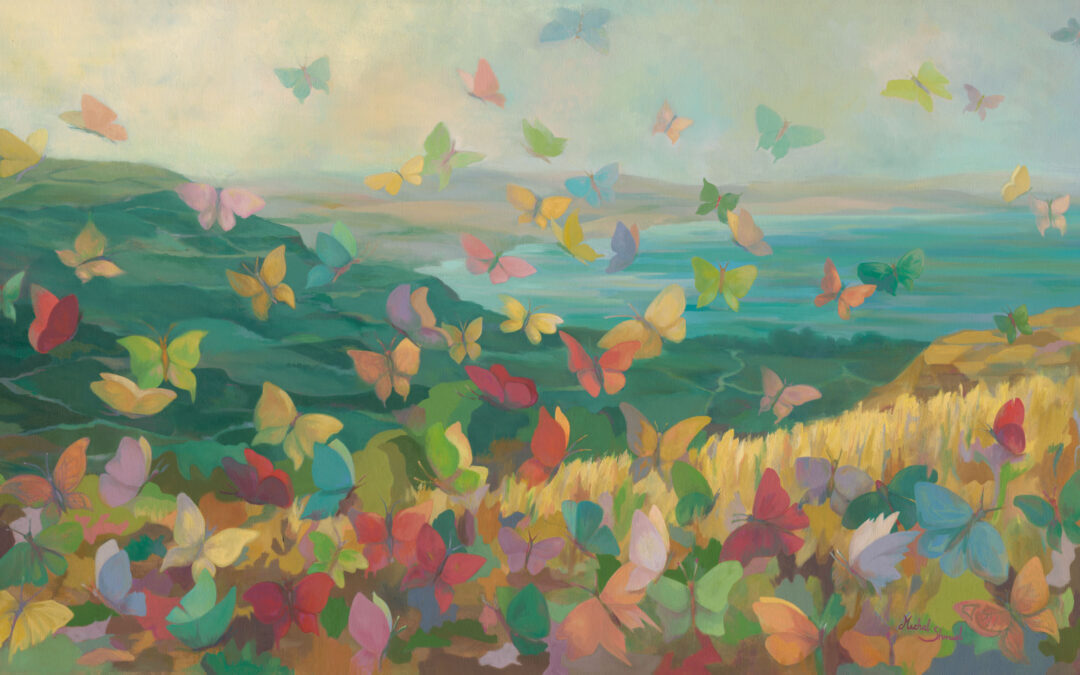
The landscape of Israel is not background. For me it has always been the main subject. The hills of the Galilee, the desert of the Negev, the coastal plain stretching toward the sea, the rocky wilderness of the Judean hills: these are not just places. They are a visual language that I have been learning to speak my whole life. My landscape paintings are my attempt to say something in that language that words cannot reach.
I come from a tradition that takes the land seriously. The connection between the Jewish people and this specific piece of earth is ancient and complicated and alive in a way that is hard to explain to someone who has not grown up inside it. When I paint the Israeli landscape I am painting that connection. Every hill I render in ochre and sienna, every olive tree I put down in deep silver-green, is a statement about belonging.
The Olive Tree as a Symbol and a Subject
The olive tree appears in my work more than any other single image. I return to it the way some artists return to the figure or the still life. The olive tree in Israel is ancient. Some of the trees still standing in the Galilee and the Golan are hundreds of years old. They have outlasted empires. They continue to fruit. They are a form of patience made visible.
Painting an olive tree is a technical challenge I find endlessly interesting. The trunk is never simply brown. It is silver, grey, violet, ochre, rust, all at once, the bark so textured that each square centimeter is its own small landscape. The leaves are small and move constantly and carry a silver underside that flashes in the wind. Getting that flash into a painting requires working quickly, with confidence, because hesitation produces a different kind of mark than the light hitting a moving leaf.
Desert Light in the Negev
The Negev desert has a different quality of silence than any other landscape I know. In Jerusalem there is always sound even when it is quiet: prayer, bells, wind through the stones. In the Negev the silence is actual. Standing there at sunrise or sunset with the desert spreading in every direction, I feel a particular quality of attention come over me. Everything sharpens. Color becomes more visible, not less. The desert is not colorless. It is full of color that most people miss because they expect it to be beige.
When I work from Negev landscapes, I bring a palette I would not use in Jerusalem. Warm dusty pinks appear. Deep terracotta runs through the rock formations. The shadows are long and blue in the early morning, shortening to purple at noon. The light is harsher than Jerusalem light and so the contrasts are stronger. Working in the desert teaches you to be decisive. There is no place to hide in that much light.
The Galilee in Spring
Spring in the Galilee is the most visually generous season in the Israeli calendar. After the winter rains the hillsides turn a green so vivid it looks almost unreal. Wildflowers appear everywhere: red anemones, yellow mustard, purple iris, white asphodel. The air is clear and the colors are saturated in a way that fades by summer when the dry heat bleaches everything back toward ochre and dust.
I try to work fast in spring. There is a window of a few weeks when the landscape is at this particular pitch of color and then it begins to change. Some of my most direct, most urgent paintings come from spring mornings in the Galilee when I am working against the clock of the season, trying to get down on canvas something that I know will not look exactly this way again for another year.
Why Landscape Painting Matters
There is a question that comes up whenever I show landscape work: why paint landscapes when photography exists? The answer I give is the same answer that applies to any comparison between painting and photography. A photograph records what the eye sees. A painting records what the whole person felt. When I paint the Galilee in spring I am not making an image of green hills. I am making an image of what it felt like to stand in that place at that moment, connected to the land in a way that is specific to my history and my identity.
Collectors who buy landscape paintings are not buying documentation. They are buying a relationship with a place, mediated by an artist who has a particular way of seeing. My relationship with the Israeli landscape is long and personal. I bring that relationship to every painting, and the people who live with my work tell me that something of it transfers. That the painting makes them feel connected to a place they may have visited once, or longed to visit, or left behind when they moved abroad.
If you are interested in seeing my Israeli landscape paintings, my full collection is available here. I work in a range of sizes from intimate pieces suited to a study or bedroom to large statement works for a living room or entrance hall. Contact me if you want to talk about what might be right for your home.