
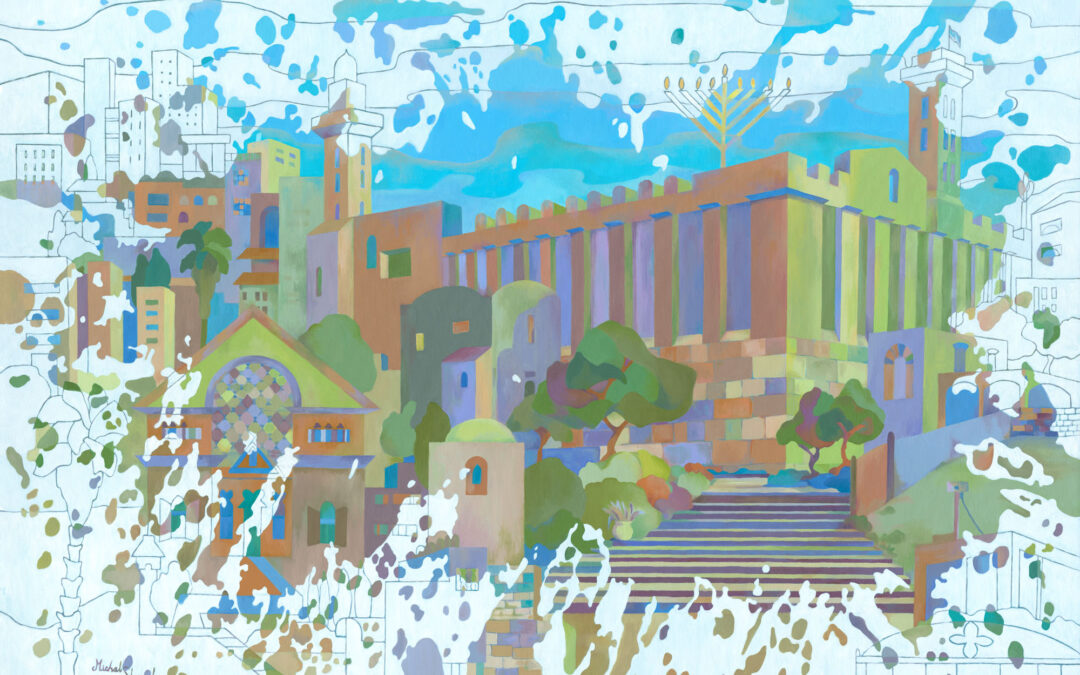
Every year when Passover arrives, I find myself returning to my canvas with a specific kind of urgency. The holiday carries so much within it: the weight of memory, the brightness of freedom, the ancient journey from slavery to the open sky. As an Israeli artist, Passover is not background noise. It shapes how I see color, how I move the brush, and what I choose to put on the wall.
My Passover paintings are not illustrations of the Exodus. They are emotional responses to it. The gold that runs through so many of my pieces is the gold of the desert at sunrise. The deep reds and burning oranges are the fire that led my ancestors through the night. The open blue that appears again and again is the sky above a free people walking into an unknown future.
Freedom Has a Color
When I think about what freedom looks like as a painting, I think about wide open spaces. I think about light that does not hide behind walls. I use broad, expansive strokes when I work on pieces that carry this theme. The canvas breathes. There is room to move. That sense of space is intentional.
In my Jerusalem pieces, you often see the architecture of the Old City. The stones, the gates, the narrow lanes. But in the works I connect to Passover and to freedom, the composition opens up. The horizon appears. The city gives way to sky and land. I want the viewer to feel the transition, that moment when the walls fall away and the journey begins.
The Seder Table and My Studio
There is something about the Seder table that reminds me of my studio. Both are places where story is told through objects. The Seder plate has its herbs, its egg, its lamb shank, each carrying a meaning that words alone cannot hold. My studio has its pigments, its brushes, its half-finished canvases leaning against the wall, each one a fragment of something larger I am working toward.
I grew up at a Seder table where the story was told with real emotion. Not just recitation but feeling. My grandfather would tear the afikomen and his hands would tremble slightly. I carry that image with me. When I paint something connected to Passover, I am trying to paint that tremble. That specific combination of memory and gratitude and grief and joy that is unique to this holiday.
Color Symbolism in Passover Art
The colors of Passover art are rich and specific. I work with a palette that comes from the land and the liturgy:
- Gold and ochre: the desert, the wheat before Chametz is removed, the ancient light of Jerusalem at dusk
- Deep crimson: the lamb’s blood on the doorpost, the wine in the cup, the sacrifice and survival intertwined
- Vivid blue: the sea that parted, the sky above the desert, the tallit worn at morning prayer
- White: purity, new beginning, the matzah, the clean table after Chametz is searched and burned
These are not choices I make consciously every time I pick up a brush. They are absorbed. They are part of how I was taught to see the world as someone who grew up connected to Jewish life and Israeli landscape in equal measure.
Art as a Form of Haggadah
The Haggadah tells us to see ourselves as if we personally left Egypt. That instruction is about imagination. It asks every person at the table to do something artists do every day: inhabit a reality that is not literally present. To feel what someone else felt. To make the past alive in the body of the present moment.
I think of my paintings as a kind of visual Haggadah. Not a literal retelling but an invitation. When someone stands in front of one of my works and feels something shift inside them, that is the same thing that happens at the best Seders. Something ancient becomes immediate. Something remembered becomes real.
Collecting Passover Art for Your Home
If you want to bring the spirit of Passover into your home through art, I suggest looking for works that carry movement rather than stillness. Passover is about journey. The best pieces will have energy in them, a sense of something unfolding rather than something fixed.
My paintings in the Jerusalem and Land of Israel collections carry this movement naturally. The brushwork is active, the color is layered. When you live with one of these pieces day after day, it changes with the light. In the morning it looks one way. At Passover candlelight it looks completely different. That responsiveness is part of what makes original art worth collecting.
You can browse my full collection here or contact me directly if you are looking for something specific for your home or for a gift. I am always happy to discuss what I am working on and what might be right for your space.